Seasonal Health
Why Millions of Chinese People Practice This 10-Minute Routine Every Morning
6/10/2026
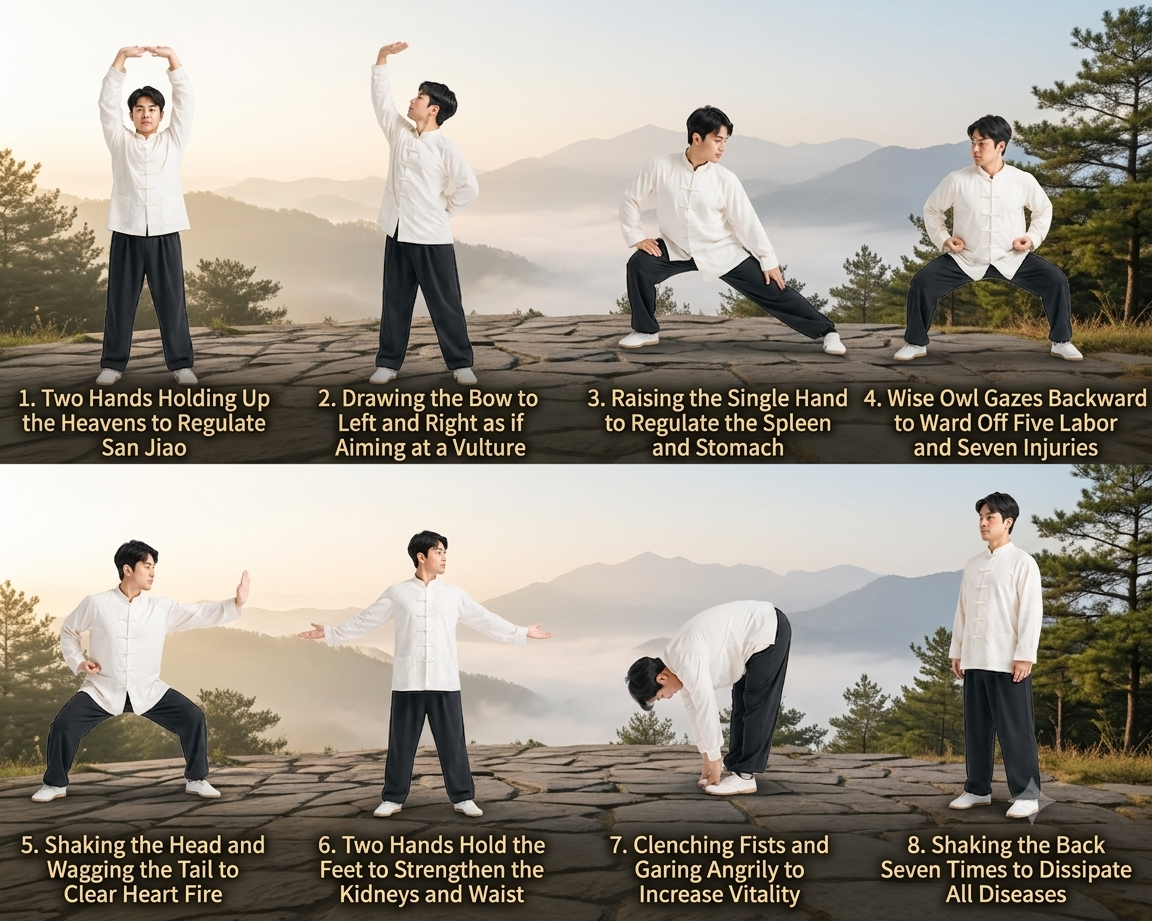
Every culture has its own morning ritual.
In the West, many people start the day with coffee, a workout, or a meditation app.
In China, millions of people begin their mornings with something much simpler: a slow sequence of movements called Baduanjin.
At first glance, it looks almost too easy to be effective.
There are no weights.
No complicated poses.
No intense cardio.
Just gentle movements, coordinated breathing, and a calm state of attention.
Yet this centuries-old practice has survived wars, dynasties, technological revolutions, and modern fitness trends.
Why?
Because it solves a problem that has become more relevant than ever: how to help the body and mind recover from the stress of daily life.
What Is Baduanjin?
Baduanjin (pronounced “Bah-Dwan-Jin”) is one of China’s oldest health practices.
The name is often translated as “Eight Pieces of Brocade,” suggesting that each movement is as valuable as a piece of fine silk.
Unlike martial arts, Baduanjin is not designed for combat.
Unlike yoga, it doesn’t require significant flexibility.
Unlike traditional workouts, it doesn’t leave you exhausted.
Instead, it combines:
- Gentle stretching
- Controlled breathing
- Postural alignment
- Mindful movement
into a routine that can be completed in about ten minutes.
Many people describe it as a form of moving meditation.
Why It Feels Surprisingly Good
Modern life places our bodies in an unnatural state.
We sit for hours.
We stare at screens.
We breathe shallowly.
We carry tension in our neck, shoulders, and lower back.
Baduanjin addresses these issues directly.
The movements encourage the spine to lengthen.
The shoulders open.
The chest expands.
The breathing becomes deeper and slower.
Within a few minutes, many people notice a sense of calm and physical ease.
It’s not because something mystical happened.
It’s because the body is finally being allowed to move the way it was designed to move.
Ancient Wisdom Meets Modern Science
Although Baduanjin originated centuries ago, modern research has begun exploring its benefits.
Studies have associated regular practice with improvements in:
- Balance and mobility
- Flexibility
- Stress management
- Sleep quality
- Overall well-being
The mechanisms are not difficult to understand.
Slow movement helps reduce excessive nervous system activation.
Deep breathing encourages relaxation.
Gentle exercise increases circulation.
Mindful attention helps interrupt cycles of stress and mental overload.
In other words, many of the benefits align with what modern science already knows about recovery and nervous system regulation.
The Perfect Exercise for Desk Workers
Perhaps the most interesting thing about Baduanjin is that it seems perfectly designed for modern office life—even though it was created long before computers existed.
Think about the common problems of desk workers:
- Tight shoulders
- Forward head posture
- Stiff hips
- Lower back discomfort
- Mental fatigue
Many Baduanjin movements specifically encourage opening the chest, extending the spine, and improving body awareness.
It’s almost like an antidote to sitting all day.
For this reason, some wellness practitioners have started referring to it as:
“The original anti-sitting workout.”
My First Week Practicing Baduanjin
The first thing I noticed was how simple it felt.
I kept waiting for the difficult part.
It never came.
The movements were slow.
The breathing was natural.
There was no struggle.
After a few days, however, something interesting happened.
My shoulders felt less tense.
My mornings felt less rushed.
And the ten minutes I spent practicing became one of the calmest parts of my day.
The effects weren’t dramatic.
They were subtle.
But they were real.
And unlike many fitness routines, it felt sustainable.
How to Get Started
One of the best things about Baduanjin is how accessible it is.
You don’t need:
- A gym membership
- Special equipment
- Athletic ability
- Previous experience
All you need is a small amount of space and ten minutes.
Start slowly.
Focus on breathing naturally.
Pay attention to how your body feels.
Consistency matters far more than intensity.
A Practice for the Modern World
The appeal of Baduanjin isn’t that it’s ancient.
Its appeal is that it remains useful.
In a world filled with constant stimulation, endless notifications, and growing levels of stress, people are searching for simple ways to feel better.
Baduanjin offers exactly that.
Not a quick fix.
Not a fitness challenge.
Just ten minutes of mindful movement that helps reconnect the body and mind.
Perhaps that’s why millions of people continue practicing it every morning.
And perhaps that’s why, after hundreds of years, it still feels surprisingly relevant today.